



For years, Electron has made desktop application development easier. Developers could use familiar web technologies like JavaScript, HTML and CSS to build applications for Windows, macOS and Linux. It helped power products such as Discord, Slack and Visual Studio Code.
But convenience comes with trade-offs. Electron bundles Chromium and Node.js with an application, introducing additional memory and resource requirements.
Discord now wants to change that.
On November 4, 2026, Discord co-founder and CTO Stanislav Vishnevskiy confirmed that the company is rebuilding its desktop client using Rust and GPUI, the GPU-accelerated interface framework developed by the team behind the Zed code editor.
Why is Discord leaving Electron?
Discord is no longer just a messaging application. It handles voice calls, video, streaming, communities and complex real-time interactions.
As applications grow, their underlying architecture can become a performance constraint.
In December 2025, Discord acknowledged testing automatic client restarts when memory consumption exceeded 4 GB. Rather than continuing to address resource consumption through workarounds, the company is now exploring a more fundamental solution.
Its new client, internally identified as Discord Phoenix, aims to improve memory efficiency, startup time and responsiveness.
Rust is only part of the story
The interesting decision is not simply choosing Rust. It is choosing GPUI.
Unlike frameworks such as Tauri, which typically use system webviews to render interfaces, GPUI allows developers to build desktop interfaces directly in Rust.
Discord is also moving away from React Native in its mobile architecture. The plan is to share application logic through Rust while retaining native mobile interfaces.
This means sharing business logic does not require forcing desktop and mobile users into identical interfaces.
The 290 MB screenshot
One detail attracted considerable attention.
Vishnevskiy shared a Windows Task Manager screenshot showing Discord Phoenix using approximately 290 MB of memory.
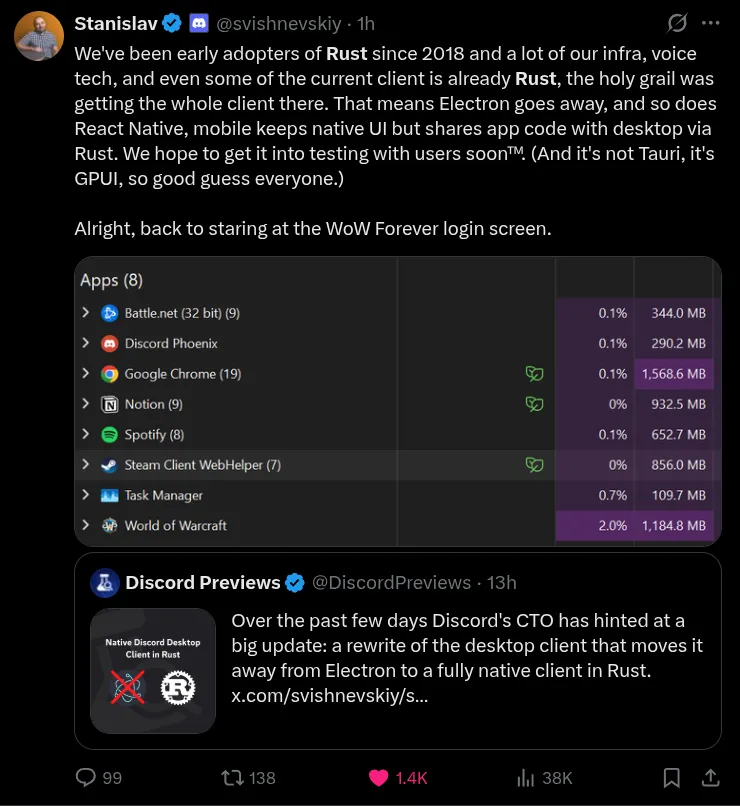
That is encouraging compared with the memory consumption associated with the existing Electron client. However, it is an early build, not a controlled benchmark. Actual performance will depend on workload and usage.
The company has also highlighted faster startup and more responsive interactions as important goals.
What developers can learn from Discord
Discord’s decision offers a valuable engineering lesson: architecture should evolve alongside the product.
When Discord adopted Electron, code reuse and development speed were sensible priorities. But as the application expanded, performance and resource efficiency became increasingly important.
Developers should watch for concrete warning signs:
- Memory growth: Does memory consumption increase during long sessions?
- Startup latency: How long before the application becomes usable?
- UI responsiveness: Do interactions remain smooth under heavy workloads?
- CPU and GPU usage: Does the application consume unnecessary resources while idle?
- Maintenance complexity: Is shared code actually reducing development effort, or creating platform-specific workarounds?
Discord is not rebuilding because Rust is fashionable. It is reconsidering its architecture because the original trade-offs may no longer serve its needs.
Electron is not dead, and not every application needs a Rust rewrite.
The bigger lesson is that good engineering is not about choosing the perfect technology on day one. It is about recognising when your product has outgrown the decisions that got it there.
We just sent a confirmation link to . Tap it and your first issue lands Sunday.

Software engineer and technical writer. He builds scalable solutions and credits the people he learned from.
More from Nowshad