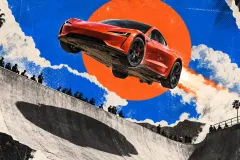

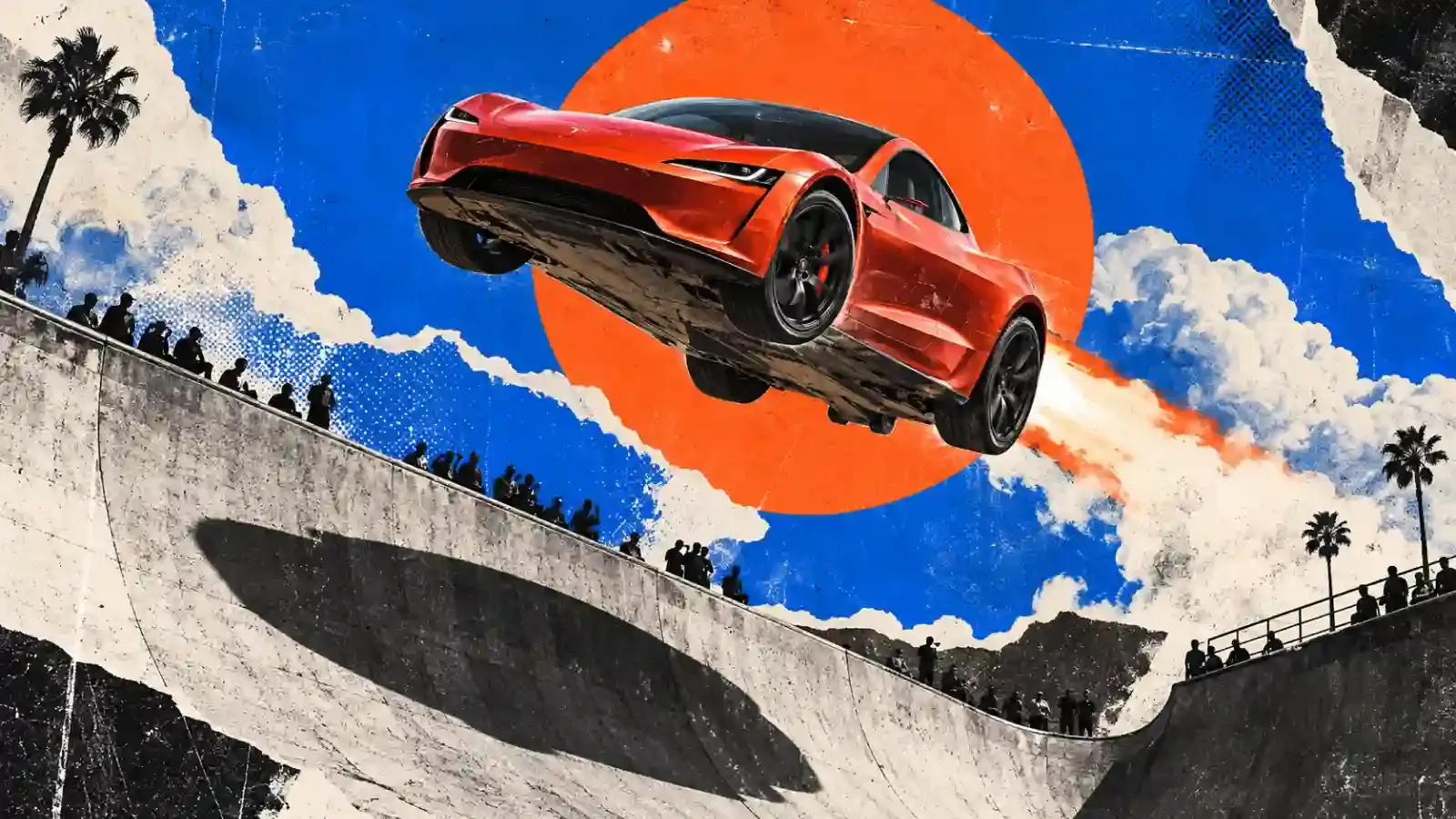
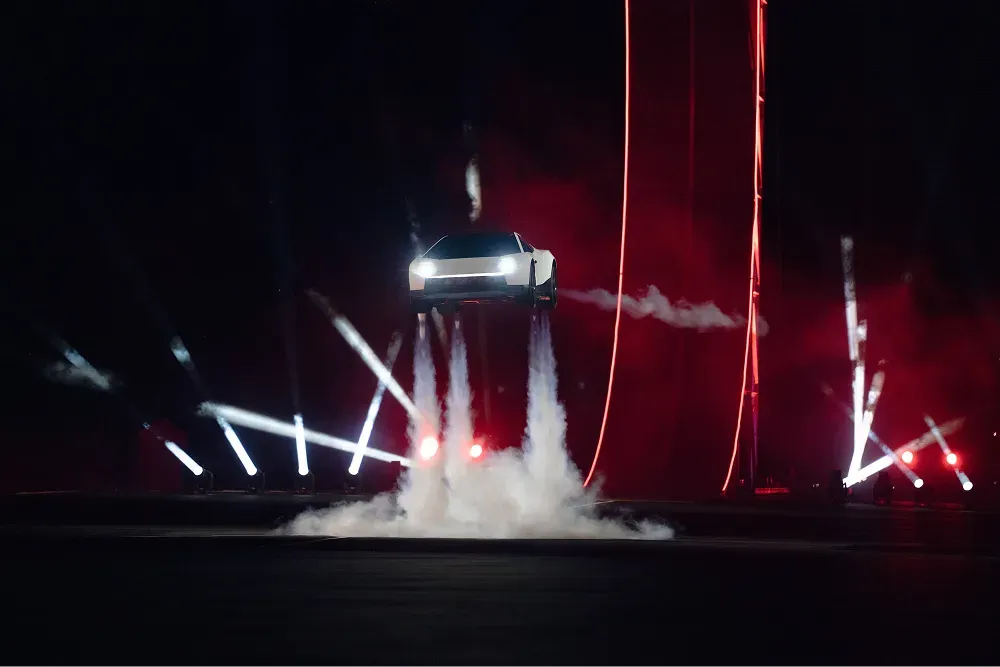
A Tesla Roadster drove up a curved ramp, clung to it upside down with the help of suction fans, then fired cold-gas thrusters, launched off the top, flipped through the air and landed safely. Electrek’s headline called the move a kickflip. Tesla staged the stunt on Thursday at a SpaceX test site in McGregor, Texas, to unveil the next-generation Roadster almost nine years after it first showed the car.
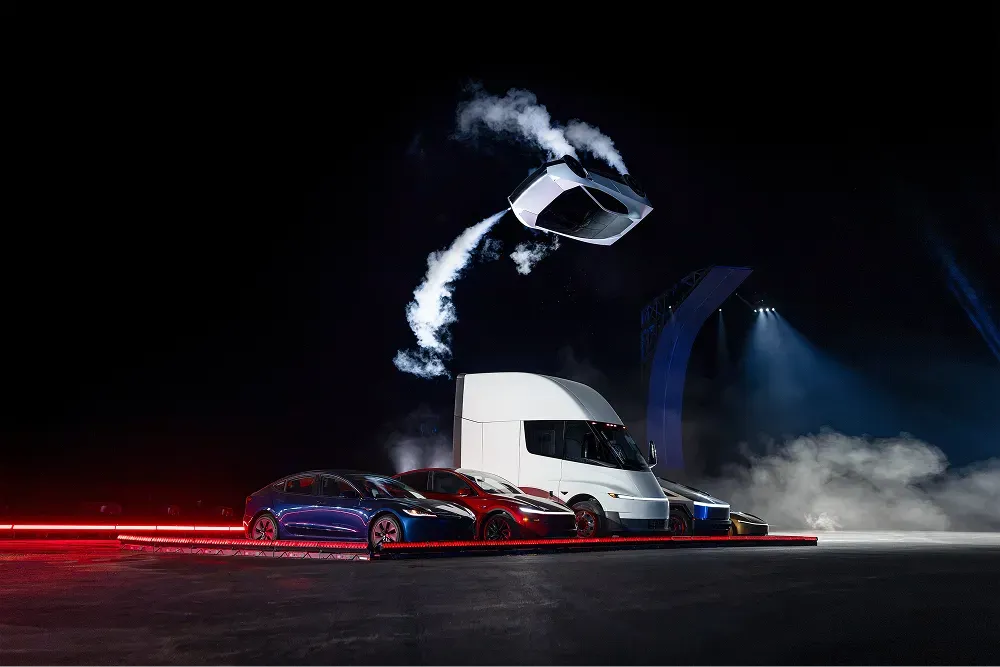
Tesla showed a 0 to 60 mph run in under a second. “Turns out the future does have flying cars,” Elon Musk said at the event. In another demo, the Roadster used its thrusters to launch over a Cybercab, a Cybertruck, a Semi, a Model Y and a Model 3, flipping midair on the way.
What Tesla says is under the skin
The thrusters are the headline, and the physics claim behind them is simple. Tesla says every car is limited by tire grip, and that the Roadster’s thrusters produce four to five times the force the tires can. More force on the same mass means harder acceleration.
To store the gas, Tesla says it packed carbon-fiber overwrapped pressure vessels into every usable void in the car. Engineering VP Lars Moravy said the setup uses 10 thrusters fed by 600 liters of compressed air, and the tank can be recharged. Fans under the body pull enough air to hold the car upside down, even when it is stationary.
In Track Mode the car lowers itself and deploys active wings driven by the same actuators Tesla built for Optimus, with downforce Tesla puts close to Formula 1 levels. The design borrows from the SR-71 and the F-35, according to Tesla, and the prototype uses steer-by-wire with a yoke.
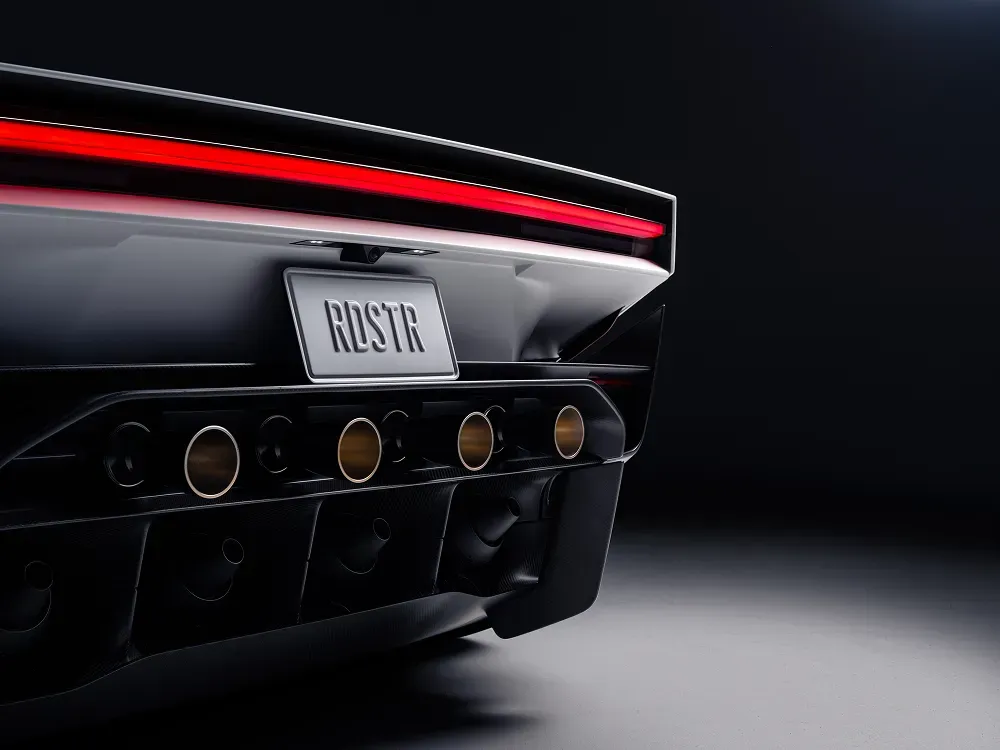
Tesla quotes about 300 miles of range and a top speed above 230 mph on the Rocket trim. After the event, Tesla posted specs for three trims: Performance (road ready, two seats, 0 to 60 mph in under 1.6 seconds), Thrust (race ready, two seats, under 0.9 seconds) and Rocket (one seat, under 0.59 seconds).
The fine print
Tesla’s own Roadster page says the Rocket trim is not approved for public road use, and it is invite only. Thrust and Rocket are “augments” on top of the Performance car.
Tesla did not announce a price for any trim. Its reservation page lists a $50,000 reservation payment for the Performance and $250,000 for the Thrust. The Performance reservation takes $5,000 up front and $45,000 within 10 days, and Tesla calls it fully refundable. Production begins in 2028, according to Musk.
The specs have shifted since 2017, when Tesla promised 620 miles of range, a top speed above 250 mph and four seats.
A long road to the ramp
Tesla first showed the Roadster at the end of its Semi reveal in November 2017 and originally said deliveries would begin in 2020. Even this unveil slipped: it was set for October 1, and Tesla pushed it two weeks, citing severe weather in the forecast. Earlier this year, unveil targets of April and August came and went. Musk floated rocket thrusters for the car back in 2018, writing that an option package would include about ten small rocket thrusters placed around the car.
Why build it
Morningstar analyst Seth Goldstein wrote in a September note that Tesla has no halo car and that the Roadster will be its new one. He expects Tesla to sell about 2,000 Roadsters a year, a small fraction of the 1.6 million vehicles it sold last year. Musk has downplayed its financial weight, saying he is not sure it moves revenue massively.
He also said it will long-term be the only manually driven car Tesla makes, which lands as the company pushes autonomy. Tesla began offering rides in its two-seat Cybercab, which has no steering wheel or pedals, in limited areas of Austin in September.
What to watch
Three things: the price, the 2028 production date, and how much of the stunt reaches a car that can legally drive on public roads. Tesla reports third-quarter results on Wednesday, October 21, so expect questions about all of it.
We just sent a confirmation link to . Tap it and your first issue lands Sunday.

Founder and editor-in-chief of BinaryBulletin. Product marketing strategist with six years of experience launching SaaS products, covering the gap between what tech promises and what it ships.
More from Mahfuz